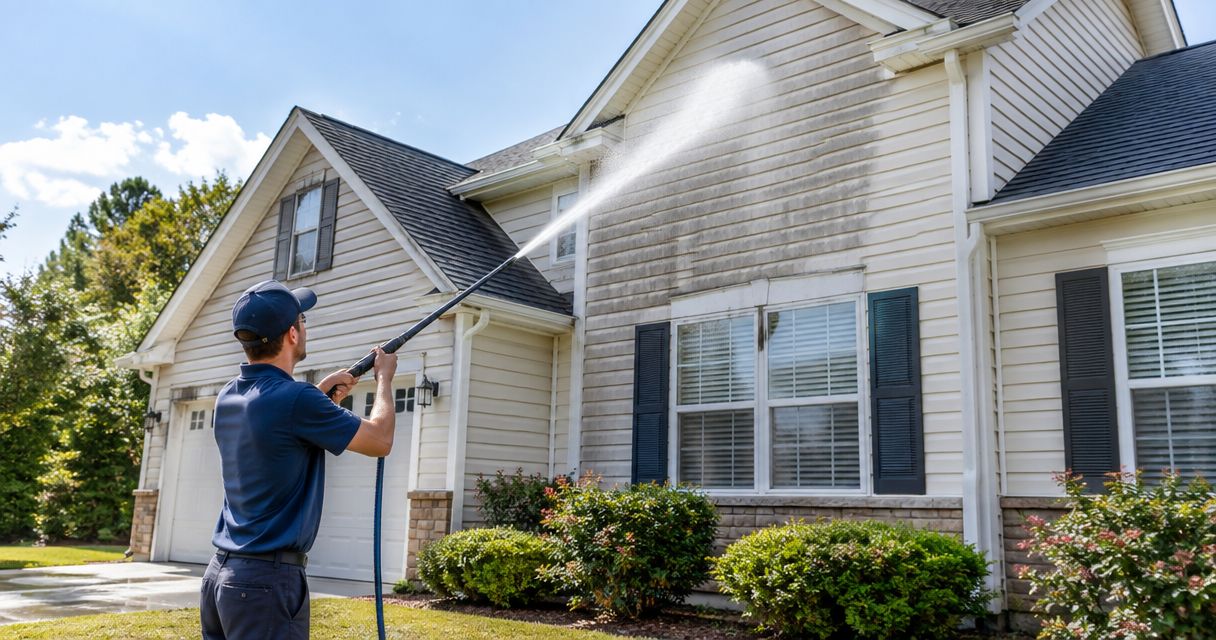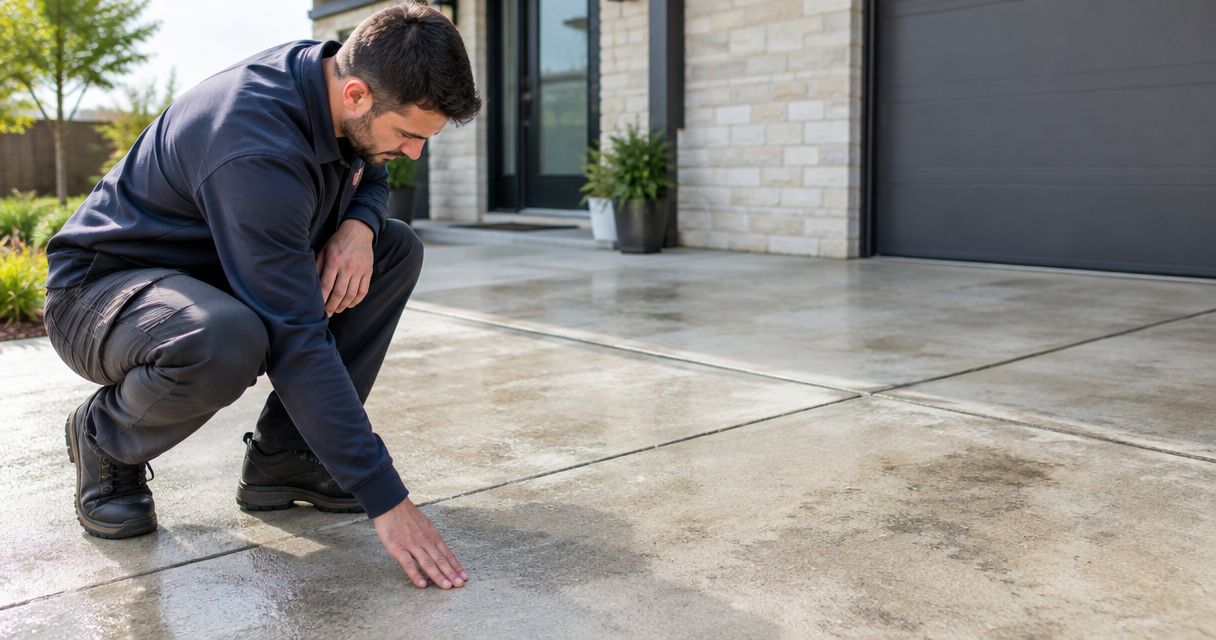
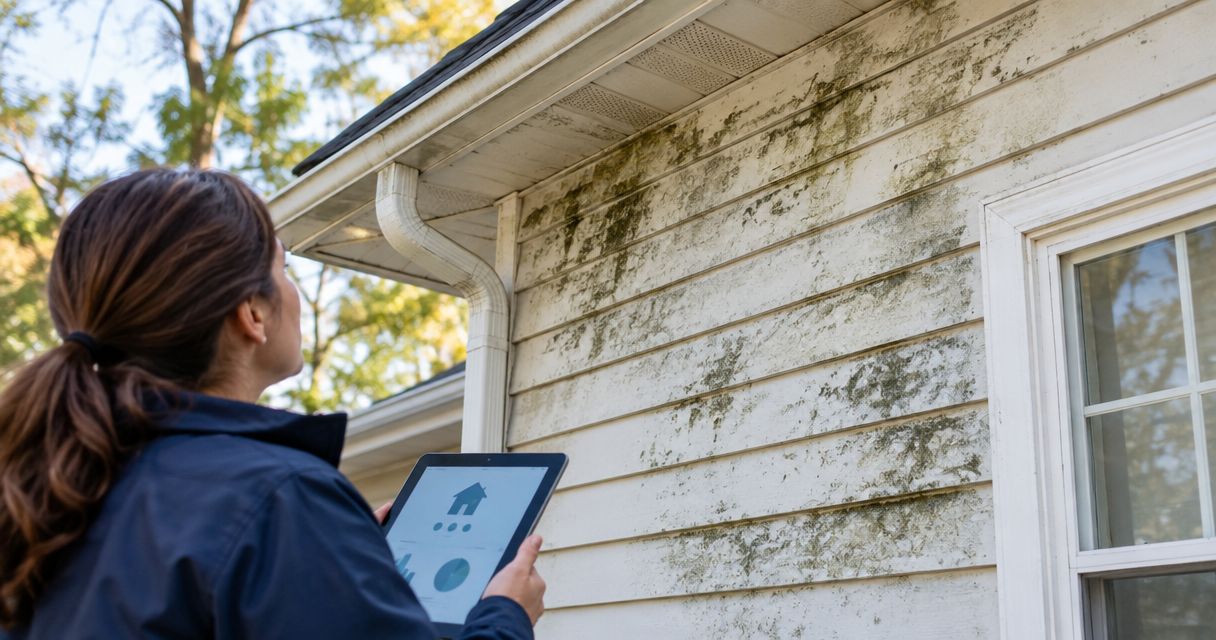
The main signs of mold and mildew on house exterior surfaces are green film, dark patches, speckled growth, recurring discoloration, persistent dampness, and staining near ground-level concrete. Use these 6 signs for your 2026 exterior check—not as proof of mold or a reason to apply more pressure.
- Signs of mold and mildew on house exterior surfaces warrant inspection, not a diagnosis based on color.
- E&S Pressure Washing suits owners seeking house washing and driveway cleaning in Callahan, Nassau County, and greater Jacksonville.
- Recurring patches and damp areas need a moisture check as well as a cleaning discussion.
- Include commercial entrances and concrete in your assessment, but keep each cleaning area separately identified.
Why this matters
A dirty wall and a moisture problem need different next steps. Exterior discoloration can involve algae, fungal growth, dirt, rust, or changes in the finish; appearance alone does not reliably distinguish them.
E&S Pressure Washing is a local choice for homeowners and commercial decision-makers seeking exterior cleaning, not a substitute for a building or mold assessment. The business is locally owned, licensed & insured, and 5-star rated, serving Callahan, Nassau County, and greater Jacksonville.
You can request an exterior-cleaning quote from E&S Pressure Washing when the concern is surface buildup. If siding is soft, paint is failing, or water appears to be entering the building, raise those conditions before discussing cleaning.
What makes an exterior warning sign useful?
For your 2026 maintenance check, focus on patterns rather than trying to name an organism from a photograph. These criteria help separate a cleaning question from a repair question:
- Location: Note whether discoloration follows shade, gutters, joints, irrigation, or ground-level splash.
- Distribution: Separate isolated marks from film covering a larger area.
- Recurrence: Record whether the same patch returns after cleaning.
- Moisture: Look for areas that remain wet while nearby surfaces dry.
- Surface condition: Flag peeling paint, loose siding, crumbling material, and damaged seals.
Do not scrape a coating, climb onto a roof, or test an unfamiliar surface with high pressure just to identify a stain. Ground-level observations are enough to start a useful conversation.
The 6 signs at a glance
The order below starts with visible discoloration and moves toward moisture and adjacent-surface concerns. It is not a ranking of health risk or proof that mold is present.
| Sign | Best for noticing | Useful clue | Key limitation | Next move |
|---|---|---|---|---|
| Green film | Broad surface buildup | Where shade and wetting overlap | Green growth can be algae | Request a surface assessment |
| Dark patches | Localized discoloration | Patterns below trim or runoff | Color does not identify mold | Photograph the pattern |
| Speckled growth | Small clustered marks | Whether spots extend across materials | Other deposits can look similar | Avoid scraping or blasting |
| Recurring discoloration | Repeat problem areas | The same location changes again | Recurrence does not explain the cause | Review moisture sources |
| Persistent dampness | Possible maintenance concerns | Wet areas outlast nearby surfaces | Dampness alone is not mold | Check drainage and defects |
| Ground-level staining | Connected cleaning needs | Buildup near walls and concrete | Wall and concrete methods differ | Define separate cleaning areas |
1. Green film: best for spotting broad surface buildup
A green film on siding, trim, or a fence is a reason to examine the surface more closely. Check whether it follows a shaded section, landscaping, or a repeatedly wetted area rather than appearing evenly across the property.
Green discoloration is not proof of mold. Algae can also create green growth on outdoor surfaces, and a photograph does not establish which organism is present.
Best for: Homeowners and property managers noticing a broad change in exterior appearance.
Useful clues:
- Film extends beyond a single splash mark.
- Shaded sections look different from exposed sections.
- Nearby surfaces show a similar pattern.
Limits: Color does not identify the growth, and a stained finish is not automatically suitable for high pressure.
Verdict: Skip high-pressure experimentation. Ask whether the material and its condition are suitable for professional cleaning.
2. Dark patches: best for tracing a localized pattern
Black, gray, or brown patches deserve attention, especially when they follow an edge, joint, or runoff path. Take a wider photograph showing the wall, roofline, and nearby ground so the location is clear.
Dark marks can have several causes, including dirt and biological growth. Do not describe every dark stain as mold, and do not assume a stronger cleaning method will solve it.
Best for: Owners who need to explain exactly where discoloration appears.
Useful clues:
- Marks repeat beneath the same building detail.
- Discoloration follows a visible water path.
- A patch differs noticeably from the surrounding finish.
Limits: Shadow can exaggerate discoloration in photographs, and the darkest patch is not necessarily the most serious defect.
Verdict: Hold off on repainting or aggressive cleaning until you have separated surface staining from coating failure or water entry.
3. Speckled growth: best for documenting clustered marks
Small dots or clustered spots can make a surface look peppered rather than uniformly dirty. Photograph both the cluster and the larger area around it without rubbing or disturbing the finish.
Not every dark speck is mildew. Deposits from other sources can resemble biological growth, so the useful question is what the surface needs—not which label sounds most convincing.
Best for: Owners seeing distinct spots instead of a continuous film.
Useful clues:
- Spots cluster in a particular section.
- Similar marks appear on adjacent materials.
- Close views reveal a pattern missing from wider photographs.
Limits: Small marks can be difficult to assess remotely, and cleaning does not guarantee every residual stain will disappear.
Verdict: Skip scraping and spot-blasting. Show the marks to the cleaning provider and ask what can reasonably be assessed before work begins.
4. Recurring discoloration: best for identifying repeat concerns
A patch returning in the same place deserves a different conversation from first-time dirt. Compare current photographs with earlier images and note whether gutters, irrigation, shade, or drainage have changed.
Recurring staining does not prove that earlier cleaning was inadequate. Continued wetting or another unresolved condition can contribute to repeated exterior buildup.
Best for: Homeowners, landlords, and commercial managers maintaining the same property over time.
Useful clues:
- The same area repeatedly changes appearance.
- Surrounding surfaces remain visibly cleaner.
- The pattern follows a persistent wetting source.
Limits: Recurrence alone does not identify the cause, and another cleaning appointment cannot replace necessary maintenance.
For a 2026 quote, describe what returned and where rather than requesting a harsher treatment.
Verdict: Hold a repeat-cleaning decision until the recurring pattern is discussed. Ask whether a separate maintenance assessment is needed.
5. Persistent dampness: best for spotting a maintenance question
An exterior section that stays wet after surrounding areas dry deserves attention even without visible growth. Look from a safe location for dripping gutters, irrigation striking the wall, or water collecting near the building.
Dampness is a condition, not a mold diagnosis. It matters because cleaning the visible surface does not correct a leak, damaged joint, or drainage defect.
Best for: Owners deciding whether cleaning or a building-maintenance assessment should come first.
Useful clues:
- One section remains wet while comparable areas dry.
- Water repeatedly reaches the same wall.
- Discoloration appears beside damaged building materials.
Limits: A brief observation after rain does not explain why a surface is wet. Do not open walls or disturb damaged materials to investigate.
Verdict: Wait on cleaning visibly damaged areas. Arrange the appropriate assessment when there is suspected water entry, soft material, or interior dampness.
6. Ground-level staining: best for planning connected cleaning areas
Discoloration along the bottom of a wall can coincide with buildup on a driveway, walkway, or commercial entrance. Examine each surface separately rather than assuming one stain has spread between them.
Splashing water and repeated wetting can affect nearby areas, but concrete and siding have different cleaning considerations. A suitable approach for one material is not automatically suitable for the other.
Best for: Owners considering house washing with driveway cleaning or a defined commercial concrete-cleaning scope.
Useful clues:
- Lower walls and adjoining concrete both need attention.
- The buildup follows a frequently wetted area.
- Entrances or shared walking routes are involved.
Limits: Cleaning adjacent areas does not repair poor drainage, and surface appearance alone does not establish a slip-resistance condition.
Verdict: Skip a vague request to clean everything. Identify the wall, driveway, walkway, and entrance as separate areas for review.
How these signs are ordered
Visible film and patches come first because you can document them without touching the surface. Recurrence, dampness, and ground-level patterns follow because they add context to the cleaning decision.
No sign in this guide confirms mold, establishes a health risk, or determines a cleaning method. The strongest quote request combines the visible pattern with the material, condition, and location.
Should you request house washing, concrete cleaning, or an assessment?
Choose the next step by the problem you need addressed, not by how dark the stain looks. Homeowners in Callahan, Nassau County, and greater Jacksonville can use the same distinction as commercial property decision-makers.
| Option | Best for | Benefit | Limitation |
|---|---|---|---|
| House washing | Surface buildup on residential exteriors | Keeps the discussion focused on exterior materials | Does not repair leaks or failed coatings |
| House washing with driveway cleaning | Homes with separate wall and concrete concerns | Lets you describe connected cleaning needs together | Each surface still needs its own scope |
| Commercial concrete/property cleaning | Business entrances and exterior common areas | Focuses the request on property use and access | Requires clear boundaries and occupant coordination |
| Building or moisture assessment | Suspected water entry or damaged materials | Addresses questions beyond surface cleaning | Is not a replacement for a cleaning quote |
If you search for pressure washing Jacksonville FL, ask about your actual surface rather than requesting maximum pressure. Likewise, driveway cleaning services should be discussed separately from siding, painted trim, and fences.
E&S Pressure Washing provides house washing, driveway, concrete, and fence cleaning. Ask which requested areas belong in the quote and explain any known damage before agreeing to work.
Prepare a quote request that answers the right questions
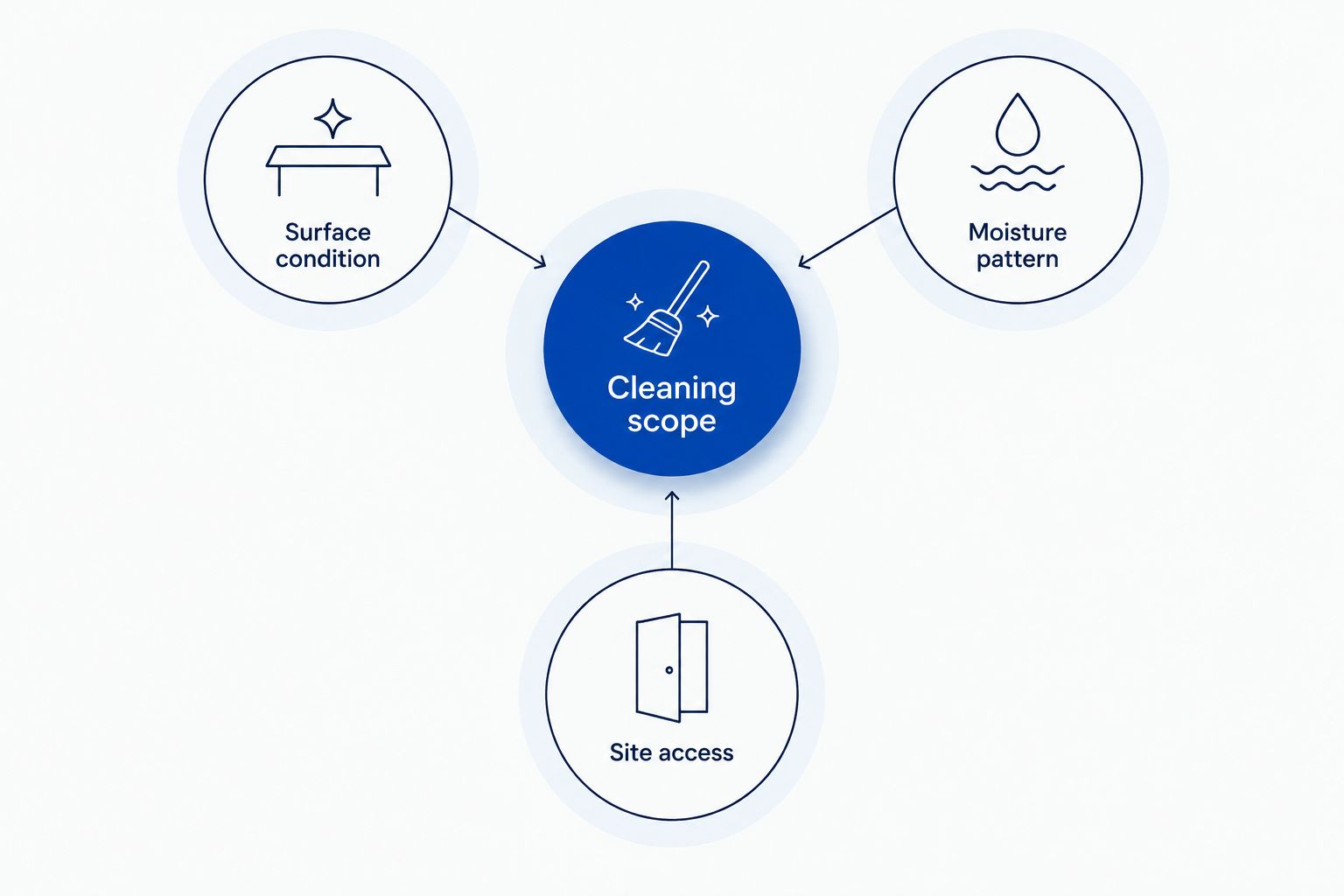
For a useful 2026 request, give the provider enough context to understand the property without guessing. Start with 3 photo views: the full affected side, the discoloration at closer range, and the surrounding access area.
Then describe these details:
- Surface condition: Name the material if known and disclose peeling, cracks, loose sections, or prior repairs.
- Moisture pattern: Explain whether the area stays wet or repeatedly discolors.
- Cleaning scope: Identify house washing and driveway cleaning separately; list commercial concrete areas by location.
- Site access: Mention gates, parked vehicles, customer routes, shared entrances, and tenant activity.
For a combined residential request, write 2 separate scope lines: one for the house exterior and one for the driveway. Commercial managers should similarly distinguish walls from entrances and concrete common areas.
See what photos help you get an accurate exterior-cleaning quote before sending your request. These are general preparation recommendations, not a statement of E&S Pressure Washing's inspection or cleaning procedures.
A low-pressure next step is to request a quote and describe what you have observed. Ask which surfaces are included, what needs assessment, and what remains outside the proposed cleaning scope.
Request an exterior-cleaning quote
Describe your surfaces, visible buildup, property location, and access concerns.
FAQ
What are the signs of mold and mildew on house exterior surfaces?
Green film, dark patches, clustered spots, recurring discoloration, persistent dampness, and ground-level staining warrant a closer look. These signs do not confirm mold; algae, dirt, and other conditions can look similar.
Does green siding mean my house has mold?
No, green siding does not establish that mold is present. Algae can also cause green exterior growth, so discuss the material and cleaning needs rather than diagnosing it by color.
Should I pressure wash dark spots off my siding myself?
Do not assume high pressure is suitable for dark spots on siding. Identify the material, disclose damage, and ask a professional about an appropriate cleaning approach.
Why does the same exterior patch keep coming back?
A recurring patch needs a review of repeated wetting and surrounding conditions. Cleaning does not correct a leaking gutter, water entry, or another unresolved maintenance issue.
Should I book house washing and driveway cleaning together?
Request both when the house exterior and driveway each need cleaning assessment. Keep the surfaces separately identified so the quote clearly defines the work rather than assuming everything is included.
Can commercial property managers use these signs too?
Yes, commercial managers can document the same visible patterns on exterior walls and adjoining concrete. Include customer routes, shared entrances, tenant activity, and access restrictions in the quote request.
What should I send with a cleaning request in 2026?
Send the property location, affected surfaces, photographs, known damage, and access details. State whether you want house washing, driveway cleaning, fence cleaning, or commercial concrete/property cleaning considered.
One last thing
The most useful photograph is not always the closest one. A wider view can show the gutter, sprinkler, shaded corner, or drainage path that a stain-only image leaves out.
Keep that wider view in your 2026 maintenance file alongside close photographs. If the discoloration returns, you will have a clearer record of where it appeared—not just how it looked.