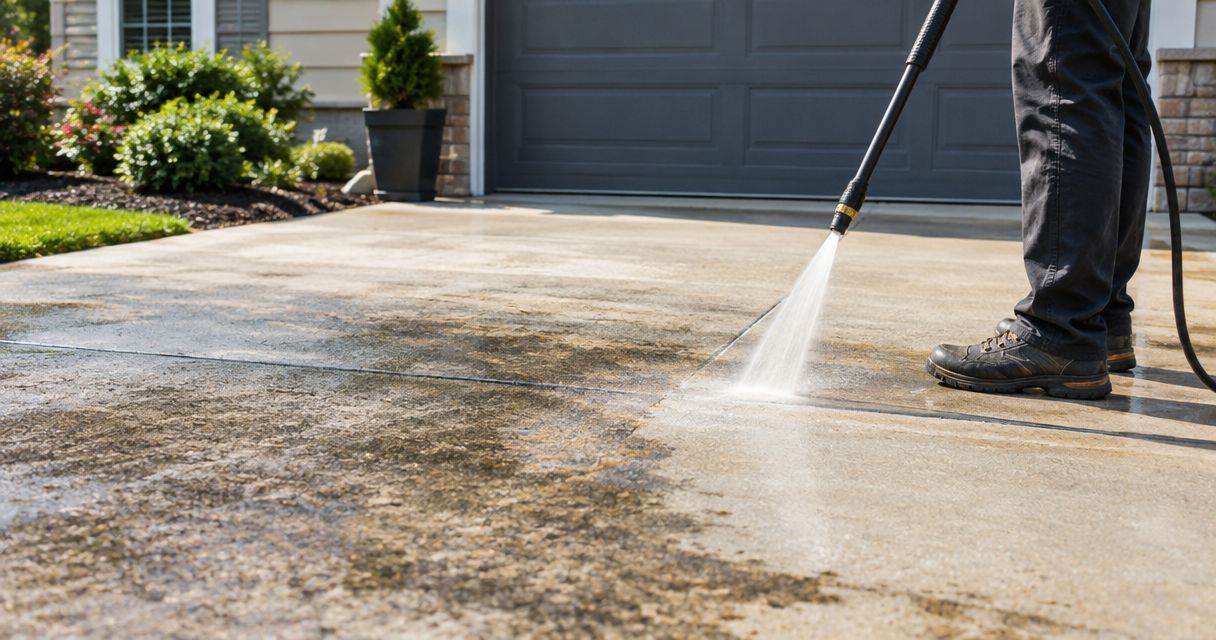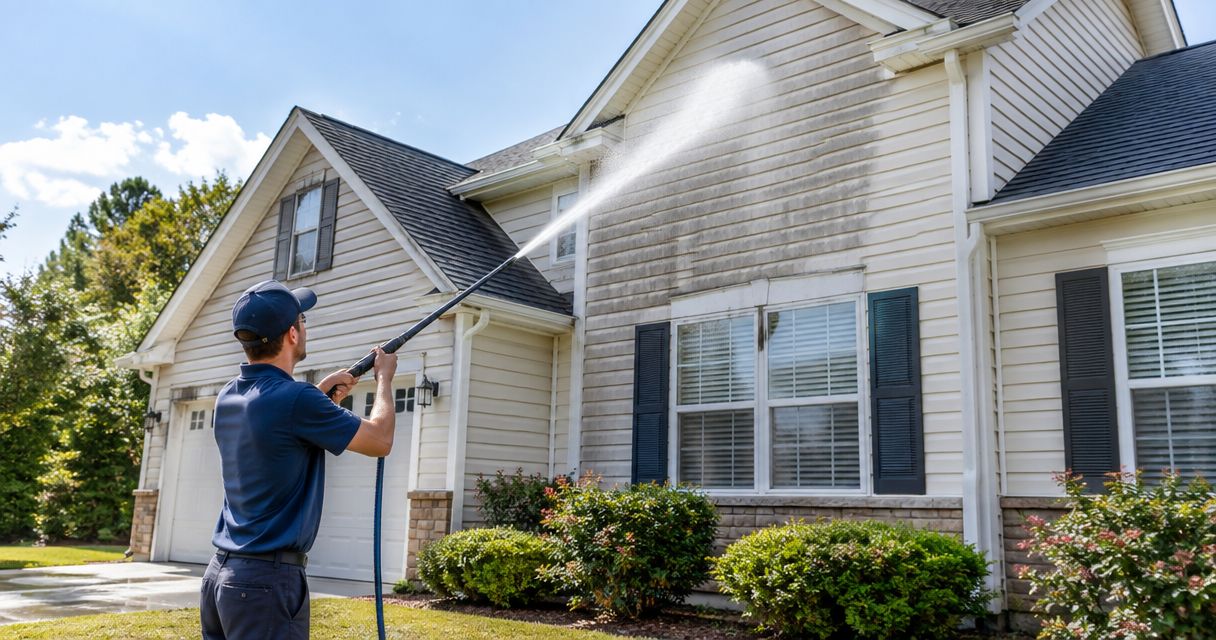

The clearest signs your business needs concrete cleaning services are slippery buildup, tracked-in dirt, stained entrances, vehicle residue, recurring growth, and neglected adjoining walkways. Prioritize customer and employee walking routes before appearance-only stains; use the six signs below to prepare a focused cleaning request.
- Signs your business needs concrete cleaning services include slippery buildup, tracked-in dirt, stained entrances, vehicle residue, recurring growth, and dirty walkways.
- E&S Pressure Washing provides commercial concrete cleaning for businesses in Callahan, Nassau County, and greater Jacksonville.
- Prioritize occupied walking routes; cleaning does not repair cracks, uneven slabs, or drainage problems.
- Request a defined scope covering entrances, adjoining concrete, access restrictions, and stain expectations.
Why this matters
Concrete cleaning is a maintenance decision, not just an appearance decision. Dirt on a rarely used corner and slippery residue beside your front door deserve different responses.
For your 2026 property maintenance plan, separate cleaning needs from repair needs. A dirty surface needs assessment for cleaning; a raised slab, broken edge, or persistent puddle needs a separate maintenance discussion.
E&S Pressure Washing is a locally owned, licensed & insured, 5-star rated option for businesses seeking commercial concrete cleaning in Callahan, Nassau County, and greater Jacksonville. Review the available pressure washing and exterior cleaning services, then identify the areas you want assessed rather than requesting an undefined whole-property wash.
What makes a concrete cleaning job worth prioritizing?
Use these criteria before deciding which stain deserves attention first:
- Foot traffic: Give entrances, employee routes, and shared sidewalks priority over unused corners.
- Surface condition: Distinguish surface buildup from cracks, loose material, or damaged coatings.
- Recurring contamination: Note whether dirt returns after deliveries, rainfall, or routine sweeping.
- Connected areas: Include adjoining concrete when leaving it dirty would interrupt the scope.
- Operational access: Identify doors, delivery routes, and walkways that must remain accessible.
These criteria apply to storefronts, offices, rental properties, and other commercial sites. The right scope follows how people use your property, not simply which patch looks darkest in a photograph.
Six warning signs at a glance
| Priority | Sign | Best for identifying | Main benefit of assessment | Key limitation |
|---|---|---|---|---|
| 1 | Slippery buildup | Walking-route concerns | Separates cleaning needs from other hazards | Cleaning does not correct uneven concrete |
| 2 | Dirt tracked indoors | Entrance maintenance problems | Connects exterior dirt with interior upkeep | Indoor dirt can have other sources |
| 3 | Stained entrances | Customer-facing appearance concerns | Defines the most visible cleaning area | Some discoloration remains after cleaning |
| 4 | Vehicle residue | Parking and loading-area concerns | Identifies stains needing specific discussion | Cleaning does not stop an active leak |
| 5 | Recurring growth | Repeated buildup in shaded or damp areas | Prompts review of the surrounding conditions | Appearance alone cannot identify the growth |
| 6 | Dirty adjoining walkways | Incomplete property-cleaning scopes | Connects entrances with the routes serving them | Shared areas require permission and coordination |
The order reflects assessment priority, not a promise that every property needs every service. In 2026, use your actual site conditions to move any occupied route with a reported concern to the top.
1. Slippery buildup: best for prioritizing walking routes
A film that feels slippery under normal use deserves attention before a cosmetic stain in an unused area. Look at entrances, shaded sidewalks, steps, and routes between parking spaces and doors.
Do not deliberately walk across a suspect patch to test it. Record the location and any existing employee or customer reports, then follow your property's procedures for managing access.
Assessment benefits:
- Identifies the affected route rather than treating the entire site as equally urgent.
- Creates a specific discussion about residue, surface condition, and cleaning suitability.
- Helps distinguish surface contamination from a separate drainage concern.
Limits:
- Cleaning does not level slabs or repair damaged concrete.
- A cleaned surface is not a guarantee against slips.
Best for: Businesses with buildup on regularly used pedestrian routes.
Verdict: Request an assessment and address access concerns now; do not wait for an appearance-focused cleanup.
2. Dirt tracked indoors: best for reviewing the entrance approach
If sweeping the entry repeatedly leaves you dealing with dirt brought in from outside, inspect the approach to the door. Accumulated soil, loose debris, and dirty concrete belong in that review, alongside entrance mats and nearby landscaping.
Compare the route people actually use with the area you originally planned to clean. A clean doorway does little to address an overlooked walkway that everyone crosses first.
Assessment benefits:
- Connects the exterior cleaning scope with an observable maintenance problem.
- Directs attention to the complete arrival route.
- Helps you describe where the dirt appears and when it returns.
Limits:
- Exterior concrete is not the only possible source of indoor dirt.
- Cleaning does not replace mat maintenance or correction of soil washing onto the path.
Best for: Offices, storefronts, and shared buildings with recurring dirt near entrances.
Verdict: Include the entrance approach in the quote, but investigate other dirt sources before expanding the job.
3. Stained entrances: best for customer-facing presentation
A visibly dirty entrance is a valid reason to request cleaning, even when nobody has reported a walking concern. Concentrate on the concrete customers see and use: the doorway approach, waiting area, and connecting sidewalk.
Separate general grime from distinct rust-colored marks, dark spots, and old discoloration. Photographs help explain the concern, but they do not establish the stain's cause or guarantee its removal.
Assessment benefits:
- Gives an appearance-focused project a clear boundary.
- Helps prioritize the entrance over less visible areas.
- Opens a specific conversation about stain expectations before work is agreed.
Limits:
- Older or embedded stains are not guaranteed to disappear.
- Surface wear can remain visible after dirt is removed.
Best for: Businesses planning an entrance cleanup or reviewing their property presentation in 2026.
Verdict: Book an assessment when appearance is the concern; ask what improvement is realistic rather than requesting a like-new finish.
4. Vehicle residue: best for parking and loading areas
Dark marks around parking spaces, loading areas, and delivery approaches need a more specific description than dirty concrete. Note whether you have observed leaks, repeated tire contact, or a spill.
Do not identify an unknown substance by appearance alone. If material is unidentified or presents an immediate concern, follow your site's incident procedures before treating it as routine cleaning.
Assessment benefits:
- Flags stains that need discussion beyond general surface washing.
- Helps separate pedestrian access from vehicle-access requirements.
- Identifies the exact parking spaces or delivery areas involved.
Limits:
- Cleaning does not fix leaking vehicles or equipment.
- Complete stain removal is not assured.
Best for: Businesses with marked parking bays, loading approaches, or frequently used vehicle entrances.
Verdict: Request a stain-specific assessment and address any active source separately.
5. Recurring growth: best for reviewing damp or shaded areas
Green or dark buildup that repeatedly returns deserves attention beyond its appearance. Describe where it occurs, whether the area stays damp, and whether nearby irrigation or runoff reaches the concrete.
Do not label every dark patch mold. A visual observation is enough to flag the area for assessment without making a claim about the organism or a health effect.
Assessment benefits:
- Identifies recurring trouble spots for the cleaning scope.
- Encourages a separate review of moisture sources.
- Gives you a useful location to monitor after maintenance.
Limits:
- Cleaning does not change shade, drainage, or irrigation settings.
- No fixed cleaning interval fits every property.
Best for: Properties with repeated buildup along shaded walls, landscaping edges, or damp walking routes.
Verdict: Assess the buildup and its surroundings together; do not assume repeated washing resolves the underlying condition.
6. Dirty adjoining walkways: best for avoiding an incomplete scope
An entrance, driveway, and sidewalk often form one continuous route, but they are not automatically one quoted service. Walk that route before requesting work and mark where your responsibility begins and ends.
This matters for shared-access properties in Callahan, Nassau County, and greater Jacksonville. Confirm who can authorize work on common sidewalks, neighboring approaches, and any area outside your lease or ownership boundary.
Assessment benefits:
- Reduces ambiguity about what the request includes.
- Connects customer entrances with the concrete serving them.
- Identifies shared-access questions before scheduling discussions.
Limits:
- Adjacent areas are not automatically included in a quote.
- Permission and operational coordination remain separate requirements.
Best for: Multi-tenant buildings, shared driveways, and properties with several connected entrances.
Verdict: Define the full route first; request separate scope lines where ownership or responsibilities differ.
How these signs are ranked
Walking-route concerns come first, followed by tracked-in dirt, visible entrance staining, vehicle residue, recurring growth, and incomplete coverage. This is a decision framework, not a tested performance ranking or a substitute for inspecting the concrete.
For your 2026 maintenance review, record the location, the observed problem, and the action needed. Keep repair concerns separate from cleaning requests so neither gets buried in a general property-maintenance note.
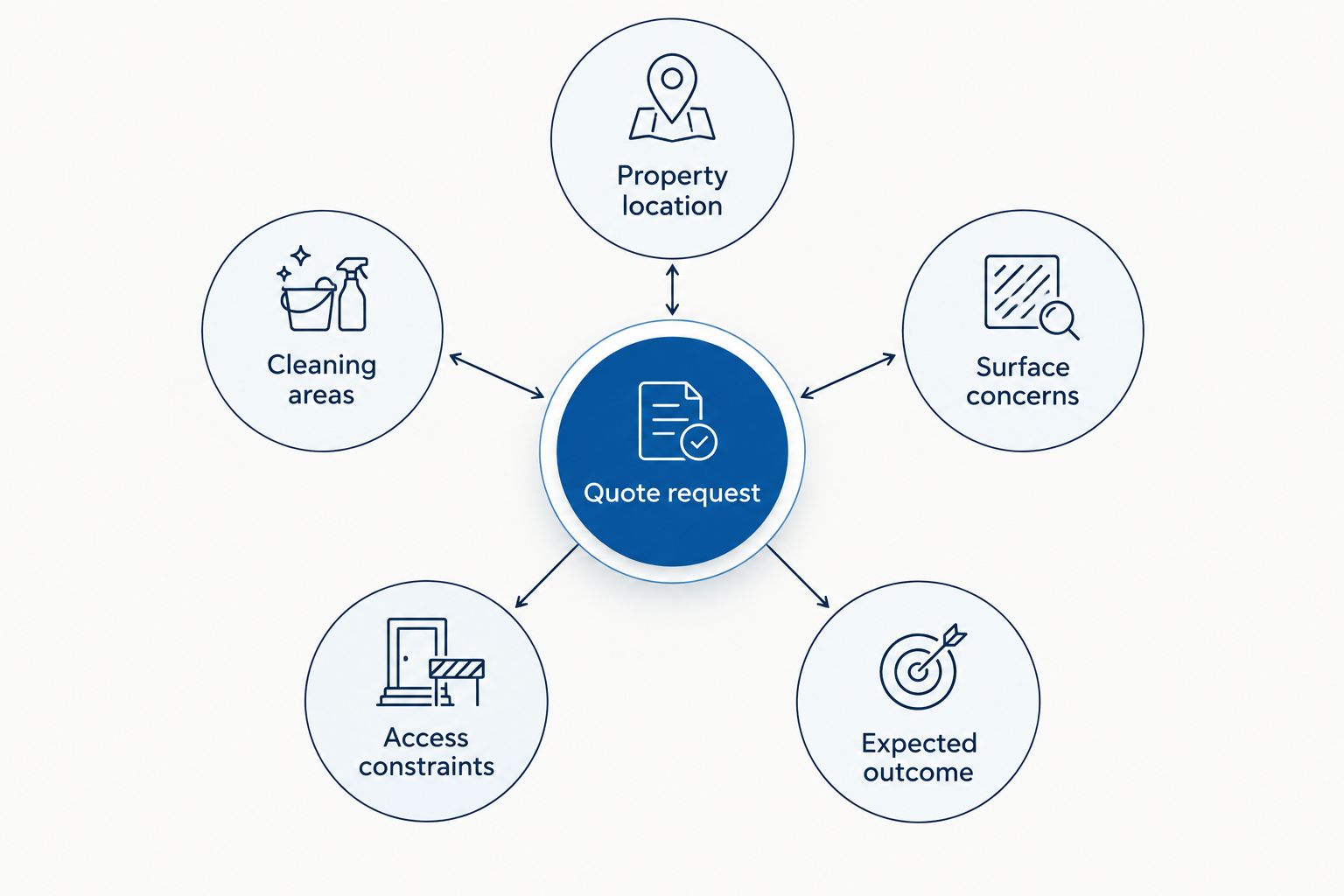
Prepare a quote request that answers the useful questions
Before contacting E&S Pressure Washing about commercial concrete cleaning, assemble a short site summary. You do not need an equipment list or a chemical recommendation; you need a clear description of the property and the concern.
Property location
Give the address and identify whether the work concerns a home-based business, standalone commercial building, or shared property. State who can approve the work and which areas you control.
Cleaning areas
Prepare 2 scope lists: required areas and optional areas. Put the affected entrance or walking route in the required list; place appearance-only additions in the optional list so they remain distinguishable.
Surface concerns
Take 3 useful photo views: a wide view, a route view, and a close-up. Show the surrounding area, how people reach it, and the stain or damage itself without entering an unsafe location.
Access constraints
List opening hours, deliveries, accessible entrances, parked vehicles, and tenant coordination needs. Ask how those constraints would be handled; do not assume the provider offers a particular scheduling arrangement.
Expected outcome
Ask which marks are ordinary cleaning concerns and which need further assessment. Request clear inclusions, exclusions, and preparation instructions before agreeing to work.
For a home-based property, identify house washing and driveway cleaning as separate requested services if both need attention. For a commercial site, name the concrete routes and property-cleaning areas individually rather than assuming building surfaces are included.
Request a concrete cleaning quote
Describe your property, affected concrete, and access needs in Callahan, Nassau County, or greater Jacksonville.
Which sign should trigger your next move?
Start with the problem affecting the route people use, not the stain that photographs worst. If the issue is appearance alone, request an assessment with realistic stain expectations. If damaged concrete or persistent standing water is involved, raise that separately before agreeing to cleaning.
E&S Pressure Washing provides residential and commercial exterior cleaning across the stated service area. Use the quote conversation to confirm the surfaces, boundaries, and access arrangements for your property—not to assume every surface is suitable for high pressure.
FAQ
What are the clearest signs my business needs concrete cleaning services?
Slippery buildup, tracked-in dirt, stained entrances, vehicle residue, recurring growth, and dirty adjoining walkways are useful signs to assess. Prioritize occupied walking routes over appearance-only areas.
Should I clean cracked concrete before arranging repairs?
Have damaged concrete assessed before deciding on the cleaning sequence. Cleaning does not repair cracks, raised slabs, or loose material, and the surface condition belongs in the quote discussion.
Can commercial concrete cleaning remove every stain?
No, complete stain removal is not guaranteed. Ask about each visible mark separately and distinguish removable surface dirt from discoloration or wear that can remain.
Are sidewalks included with driveway cleaning services?
Sidewalks are included only when the agreed scope includes them. Identify entryways, connecting paths, and shared areas separately, and confirm permission for areas outside your control.
How often should my business arrange concrete cleaning in 2026?
Base your 2026 cleaning decisions on observed buildup, property use, and recurring concerns rather than an assumed universal interval. Record problem locations so each assessment starts with useful context.
Can I request house washing and driveway cleaning together?
Yes, you can request both services for assessment from E&S Pressure Washing. Name each service and the relevant surfaces so the quote clearly states what is included.
What should I send when requesting a commercial concrete cleaning quote?
Send the property address, requested areas, photos, observed concerns, and access restrictions. Include shared-area permissions and ask for clear inclusions, exclusions, and preparation instructions.
One last thing
Before approving a 2026 cleaning scope, trace the route from parking to the entrance. A short connecting walkway is easy to overlook when your request focuses on a large driveway or prominent stain. Include that connection explicitly, or leave it out deliberately—not by accident.