You can park after driveway cleaning services once the contractor confirms the work is finished and the surface is ready for vehicle traffic; a dry-looking driveway alone is not clearance. If the job includes a sealer, coating, or repair, follow that product’s vehicle-use instructions rather than the cleaning schedule.
- After driveway cleaning services, confirm vehicle clearance with the contractor; appearance alone does not establish readiness.
- Cleaning-only work and sealer application require different parking decisions.
- E&S Pressure Washing serves homeowners and businesses arranging driveway and exterior cleaning in Callahan, Nassau County, and greater Jacksonville.
- Plan alternative parking and ask about pedestrian access before work begins.
Why this matters
A parking plan belongs in your cleaning quote, not in a last-minute conversation while someone needs to leave. You need to know whether the driveway will be inaccessible, how people will reach the building, and who will confirm when vehicles can return.
For homeowners and commercial property decision-makers in Callahan, Nassau County, and greater Jacksonville, the useful question is not simply how quickly concrete dries. It is whether the actual work allows vehicle traffic to resume.
E&S Pressure Washing is a fit for homeowners and businesses seeking local driveway and exterior cleaning. The company is locally owned, licensed & insured, and 5-star rated. When you request a driveway cleaning quote, include your parking and access requirements alongside the surfaces you want cleaned.
When can you park after driveway cleaning?
Park when the contractor releases the driveway for vehicle use, with any treatment restrictions satisfied. Before moving a car, confirm that cleaning is complete, equipment is clear, and no separate instruction keeps vehicles off the surface.
These are different job scopes, not interchangeable waiting periods:
| Work scope | Best for | What determines parking readiness | Main limitation |
|---|---|---|---|
| Cleaning only | Removing surface dirt and buildup without adding a finish | Completion of cleaning and the contractor’s return-to-use instructions | A visibly dry patch does not confirm the whole work area is ready |
| Cleaning followed by sealer or coating | Projects that separately specify a surface finish | The applied product’s instructions for vehicle traffic | Dry to the touch is not the same as ready for tires |
| Cleaning alongside surface repairs | Projects that separately include repair work | The repair material’s instructions and the contractor’s release | Cleaning completion does not end a repair-related restriction |
Sealing, coatings, and repairs are scope distinctions for planning purposes, not statements about services offered by E&S Pressure Washing. Ask what your quote includes instead of assuming another property’s experience applies to yours.
For your 2026 booking, request a clear answer to this question: What needs to happen before I can drive onto the finished area? That answer is more useful than a timing estimate that does not identify the work involved.
Cleaning only: confirm completion before moving vehicles
If your driveway is being cleaned without a sealer, coating, or repair, ask for instructions specific to the cleaned surface. Do not borrow a waiting period from advice about newly poured concrete or a newly applied finish; those are different situations.
Check whether the contractor has finished the entire route your tires will follow. A completed section near the garage does not help if the entrance is still being cleaned or equipment remains across the access route.
Before returning a vehicle, confirm:
- The contractor has finished the driveway work.
- Hoses, tools, and other equipment are clear of the vehicle route.
- Any surface-specific restrictions have been explained.
- The intended parking area and its entrance are released for use.
The advantage of a cleaning-only scope is a simpler return-to-use question: you are not also managing a new finish’s instructions. The limitation is that surface condition and the actual work still matter; cleaning-only does not justify an automatic promise about parking time.
Sealer or coating: use the vehicle-traffic instructions
If a separate contractor or project scope includes a sealer or coating, get the exact product instructions. Ask specifically about vehicle traffic, because an instruction for touching or walking on a surface does not answer whether you can park on it.
Do not treat a dry-looking finish as permission to park. The product’s instructions and the installer’s guidance govern that decision, including any conditions that change the return-to-use period.
A finish adds a separate decision to your 2026 parking plan. Record who applied it, which instructions apply, and who will confirm that vehicles can return.
Keep these details with the job paperwork. If the cleaning contractor and finish installer are different businesses, establish which person is responsible for giving the final parking instruction before either job begins.
Repairs: keep the repaired area under its own instructions
Cleaning and repair work should not share an assumed reopening time. If a driveway project includes patched areas, joint work, or another repair, ask the person responsible for that work when vehicles can cross and park on it.
A repair can affect the route even when the planned parking space is elsewhere. Tell the contractor where vehicles need to travel, not just where you intend to leave them.
The practical benefit of identifying repairs early is a clear work boundary. The limitation is that a completed cleaning visit cannot establish readiness for a material installed under a separate scope.
Why the parking wait varies
A useful parking instruction accounts for the job rather than repeating a universal clock time. These factors belong in the conversation:
- Work scope: Cleaning alone is different from cleaning followed by a separately specified finish or repair.
- Surface type: Tell the contractor whether the driveway is concrete, pavers, or another material, including any known finish.
- Surface condition: Point out cracks, loose areas, worn finishes, and previous repairs so they can be assessed.
- Weather and exposure: Discuss shade, rainfall, and drying conditions rather than relying on how a sunny section looks.
- Access layout: Explain whether vehicles must cross another work area to reach the parking space.
- Property use: A household driveway and an occupied commercial entrance need different access arrangements.
These factors support questions, not a self-issued clearance checklist. Your role is to describe the property and constraints; the contractor’s role is to explain the planned work and its return-to-use requirements.
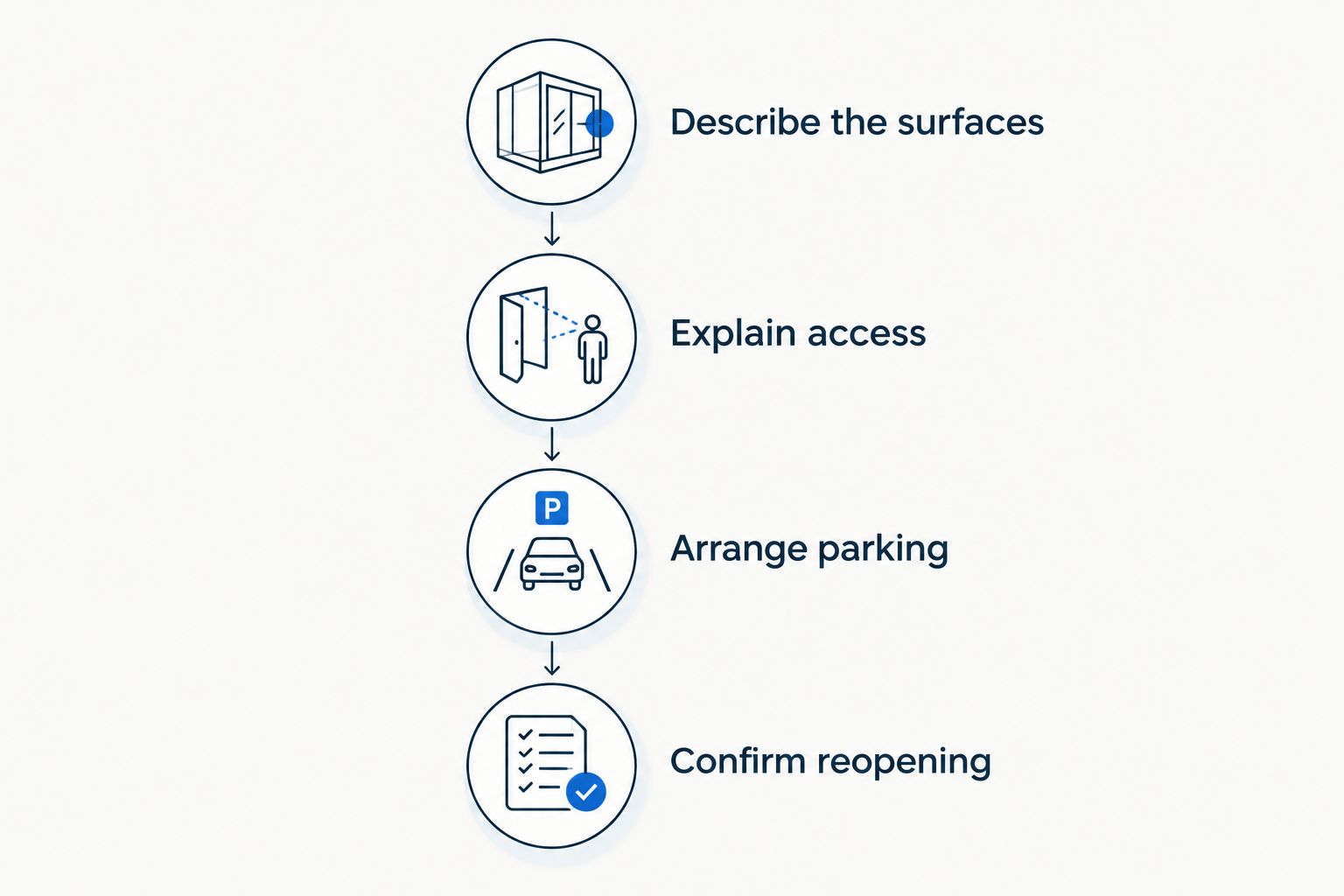
How to prepare your parking plan before the visit
Use this sequence when arranging a 2026 cleaning visit. It keeps the quote focused on what you need to use, when you need access, and what remains outside the job.
Describe the surfaces
List the driveway, house exterior, walkways, and any other areas you want considered. Mention known sealers or repairs and send photographs of areas that concern you, without assuming a photograph establishes the cleaning method.
For a business, identify entrances, customer parking, pedestrian routes, and concrete areas included in the request. Separate areas you want cleaned from areas that only need to remain accessible.
Explain access
Describe who needs to enter or leave during the work. Include garage access, shared driveways, deliveries, visitor parking, and any route that cannot simply be blocked without a plan.
Do not assume that leaving a narrow gap provides suitable access. Ask the contractor to explain what arrangement is practical for the proposed work.
Arrange parking
Choose an alternative location where you are permitted to park. Check that moving vehicles there will not obstruct a neighbor, a pedestrian route, an entrance, or an area needed for the work.
Tell everyone using the property when vehicles need to be moved. Include a vehicle stored in the garage if its driver will need to leave before the driveway is released.
Confirm reopening
Ask who will tell you the driveway is ready and how that message will reach everyone affected. If you will be away, agree on a communication method before work starts.
Keep the instruction specific: vehicle access, pedestrian access, and access to adjacent work areas are separate questions. A general statement that the job is finished should not leave those details unresolved.
Should you combine house washing and driveway cleaning?
Ask for house washing and driveway cleaning in the same quote when both areas need attention. That gives you a chance to discuss the complete work area and the order of access restrictions instead of planning each surface separately.
The benefit is a clearer combined scope. The trade-off is that more of the property requires coordination, particularly where a driveway, entrance, and house exterior meet.
Ask whether the planned work affects your route to the front door or garage. Do not assume that a completed driveway means adjacent exterior cleaning is also finished, and do not assume a combined request includes a discount.
For a 2026 household plan, identify the essential movement first: leaving for work, returning home, or reaching the entrance. Then ask how the proposed scope accommodates that need without promising uninterrupted access.
How should commercial properties manage parking access?
Commercial cleaning needs an access plan that accounts for people who are not part of the booking conversation. Staff, customers, tenants, and delivery drivers need consistent instructions about where they can go.
For properties in greater Jacksonville, Callahan, and Nassau County, identify the person authorized to communicate closures and reopening. Give the contractor the relevant site constraints before accepting the scope.
Useful questions include:
- Which parking spaces and concrete areas are included?
- Which entrances need an agreed alternative route?
- Who will notify occupants and delivery contacts?
- Who will manage signs or barriers if they are needed?
- Who will confirm that each work area is released?
Do not promise that every section can stay open during cleaning. Request an access arrangement that fits the site, then communicate the agreed arrangement rather than an assumed one.
The guide to pressure washing for Jacksonville commercial property managers addresses the broader property-management scope. Parking readiness remains a specific question to settle for each work area.
Can I park if the driveway still looks wet?
A wet appearance does not, by itself, answer whether you can park. Ask whether the cleaning is complete, whether any treatment restrictions apply, and whether the contractor has released the vehicle route.
Avoid replacing the actual instruction with your own visual judgment. That applies both ways: a wet-looking area and a dry-looking area each need to be considered in the context of the work performed.
Can I walk on the driveway before parking on it?
Pedestrian access and vehicle access are separate permissions. Ask for both, especially if the driveway is also the route to your front door, business entrance, or accessible entrance.
If another route is needed, agree on it before cleaning begins. Do not direct occupants through an active work area because the alternative has not been discussed.
What should I ask before accepting a cleaning quote?
Ask what is being cleaned, what is excluded, when vehicles must be moved, and how reopening will be confirmed. Also ask how existing surface concerns will be assessed and whether any separate finish or repair instructions apply.
E&S Pressure Washing provides house washing, driveway, concrete, and fence cleaning for residential and commercial properties. Request a quote with the relevant surfaces and access needs; ask which arrangements apply to your property rather than assuming a particular method or schedule.
Request a driveway cleaning quote
Share your surfaces, property location, and parking or entrance access needs.
FAQ
How long after driveway cleaning services can I park?
Park after driveway cleaning services when the contractor confirms the area is ready for vehicle traffic. If sealing, coating, or repair work is involved, follow the applicable product instructions as well.
Can I park as soon as my concrete driveway looks dry?
A dry-looking concrete driveway does not establish permission to park. Confirm that work is finished and that no separate treatment or repair restriction applies.
Should I move my car out of the garage before driveway cleaning?
Move your car beforehand if you need it while driveway access is restricted, using the arrangement agreed with the contractor. Include garage vehicles when you discuss access during booking.
Does driveway cleaning include sealing?
Do not assume driveway cleaning includes sealing. Ask for an itemized scope that distinguishes cleaning from any separately specified finish or repair.
Can customers use a parking area while concrete cleaning is underway?
Customer access needs a site-specific arrangement agreed before work begins. Confirm which areas are restricted and who will communicate closures and reopening.
Can I book house washing and driveway cleaning together?
Ask for both services in the same quote when both surfaces need attention. Discuss the work sequence and access arrangements without assuming a discount or uninterrupted entry.
What should I send E&S Pressure Washing when requesting a quote?
Send your property location, the surfaces you want cleaned, photographs of concerns, and your parking or entrance requirements. Include known finishes or repairs and whether the property is residential or commercial.
One last thing
Your parking space is only part of the access question: your tires must also cross the driveway entrance to reach it. For your 2026 booking, ask whether the full vehicle route is ready, not just the spot where the car will sit.
Keep the next step simple. Request a quote, describe the access you need, and ask for clear vehicle-return instructions before the work begins.